
What is a hotel pricing strategy (and how is it different from just "setting rates")?
A hotel pricing strategy is an ongoing system for deciding what a room price should be for each date, segment, and channel - not a static seasonal price list you set once in January. It balances guest perception with profitability by accounting for local market trends, customer types, and competitor actions.
Unlike simple rate setting, a pricing strategy considers market demand, seasonality, competition, operational costs, and perceived value. It connects directly to revenue management concepts: RevPAR (room revenue divided by available rooms), ADR (average daily rate), and TRevPAR (total revenue per available room including F&B and ancillaries). For most 3-4 star independents, ADR benchmarks sit between €130-€180.
Concrete example: The same standard double room in a 50-room Lisbon hotel might be €139 on a low-demand Tuesday in February (40% occupancy forecast) and €259 on a high-demand Saturday in August during festival season (95% projected occupancy). That's an 86% RevPAR gap between static and dynamic approaches.
Travelers now accept dynamic room prices - Booking.com data shows 68% of users expect rates to fluctuate based on demand, with 42% willing to pay 20% or more during high-demand dates.
Laying the groundwork: rooms, costs, and market position
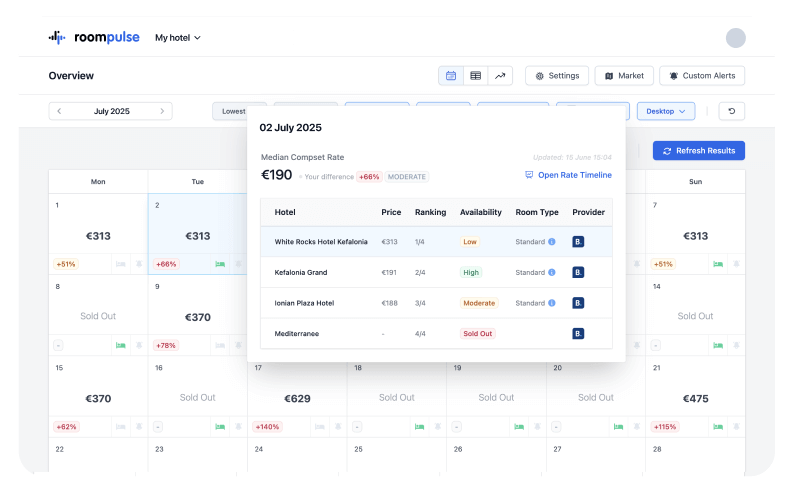
No pricing strategy works well without understanding your baseline economics and market role. Before adjusting rates, you need clarity on three things: inventory perishability, cost structure, and competitive positioning. Your hotel's location directly shapes demand - proximity to business districts, transport hubs, and attractions defines both your target market and the competitive set you should benchmark against.
Perishable room inventory
Once 14 May 2026 passes, unsold room nights generate zero revenue forever. Industry data shows 30% of room nights remain unsold during soft periods - that's money left on the table. Pricing must reflect urgency as the booking date approaches.
Cost structure
Your minimum viable rate emerges from combining fixed and variable costs:
| Cost type | Examples | Typical % of expenses |
|---|---|---|
| Fixed costs | Salaries, leases, utilities, insurance | 55-70% |
| Variable costs | Housekeeping (€10-15/room/night), breakfast (€8-12/head) | 30-45% |
For a 60-room hotel with €450,000 in annual fixed costs targeting €150,000 profit (25% margin), the math: €600,000 total costs divided by 21,900 room nights equals roughly €35-€45 breakeven. At 70% occupancy, you'd need an operational ADR of €120-€160 to hit your goals.
Market positioning
Where do you sit: budget (€80-€120 ADR), midscale (€130-€180), or premium (€200+)? Identify 5-8 true competitors - same star rating, similar location, comparable room types. A 4.2+ TripAdvisor score typically justifies a 10-15% premium over lower-rated properties, giving you pricing power in negotiations.
Key factors that influence hotel room pricing
The right room price emerges from intersecting market demand, internal performance, and guest behavior. Here are the signals every independent hotel should monitor.
Market demand and local events
Demand spikes 25-50% around major events. Barcelona's Primavera Sound in June 2026 projects 92% citywide occupancy. School holidays, convention calendars, and weather patterns all affect what guests are willing to pay on specific dates. Tracking local events lets you capture demand trends before competitors react.
Seasonality and day-of-week patterns
Business cities peak Tuesday through Thursday (London ADR runs €20 higher midweek), while leisure destinations see weekend and holiday premiums (Cornwall Saturday rates command €50+ more). Map your own demand patterns using historical data from the past 12-24 months.
Booking pace and pick-up
Monitoring daily pick-up versus previous months and years reveals whether current rates are too high or too low. If you're at less than 20% booked 90 days out compared to 60% last year, rates may need adjustment. Booking pace is your early warning system.
Competitor pricing
Watching competitor rates on Booking.com, Expedia, and Agoda shows market positioning. But simple undercutting backfires if you're offering superior value - you train guests to expect lower prices without gaining meaningful share.
Guest mix and segmentation
Business travelers tolerate higher ADR (often 20% more) with shorter length of stay. Leisure travelers and groups expect volume discounts. Your channel mix between direct bookings, OTAs, and corporate contracts shapes overall margin.
Online reputation and value perception
Review scores justify premium rates. A 4.5+ OTA score enables roughly a 12% ADR premium over lower-rated competitors. Guest satisfaction and service quality translate directly into pricing power.
Core hotel pricing strategies: the building blocks
Most independent hotels don't need 20 different pricing methods. They need to master a core set and combine them intelligently. The most common approaches in the hotel industry are occupancy-based, dynamic, and segment-based pricing - each designed to manage supply and demand and address specific market conditions.
Dynamic pricing and demand-based pricing
Dynamic pricing adjusts room rates in real-time based on supply and demand. Unlike seasonal pricing with fixed rate bands, true demand-based pricing reacts to specific dates - concerts on 20-22 June 2026, long weekends, school breaks.
Example: A 35-room Barcelona hotel sets festival weekend rates at €180 (based on 85% occupancy last year), then raises them to €240 as pick-up hits 70% sold 30 days out.
Whether driven manually (daily PMS reviews) or automated via an RMS, the logic stays the same: charge more when demand is strong, less when it's weak.
Pros: 15-25% RevPAR lift potential. Cons: Requires consistent data monitoring.
Occupancy-based pricing
Occupancy-based pricing adjusts rates based on how full the hotel is at any given time. A simple tier structure might look like:
| Occupancy level | Rate example |
|---|---|
| Below 30% | €99 |
| 30-60% | €129 |
| 60-80% | €159 |
| Above 80% | €199 |
When occupancy falls below a threshold, hotels lower prices to attract more guests; when it climbs past 70%, rates step up. This approach reacts to what has already happened rather than future demand, so it works best when combined with forecasting and competitor data.
Pros: Simple to implement, intuitive for staff. Cons: Backward-looking; misses future demand signals.
Forecast-based pricing
Forecast-based pricing sets room rates based on expected future demand, using historical data and market trends to plan days, weeks, or months in advance. Compare August 2025 versus August 2026: if last year's sell-out for 15 August was at €189 with 95% occupancy, you might open this year at €199-€209, adjusting as pick-up develops.
Quality data matters: you need at least 12-24 months of history plus visibility into upcoming events and school calendars. Tools like Roompulse surface local events and competitor pricing changes that improve forecast accuracy.
Pros: Proactive rather than reactive. Cons: Requires good historical data.
Length-of-stay (LOS) pricing
LOS pricing adjusts rates based on the duration of a guest's stay, incentivizing longer stays to reduce operational costs and stabilize occupancy. "Stay 3, pay 2" midweek offers or minimum 3-night stays on holiday weekends are common applications.
Example: A 50-room city-center hotel requires a 3-night minimum stay from 29-31 December 2026 for New Year's, avoiding single-night gaps that block longer bookings.
Benefits: Fewer check-ins/check-outs, lower cleaning costs, more predictable occupancy. Caution: Overly strict rules reduce conversion if local demand favors short city breaks.
Segment- and guest-type-based pricing
Different customer segments warrant different prices. Segment-based pricing offers distinct rates for corporate contracts, OTA leisure, direct website bookers, groups, and long-stay guests.
Example: Corporate rate agreements for 2026 guarantee 200 room nights at a discounted weekday rate (€140), versus €170 BAR for ad-hoc business travelers. Guest-type pricing like senior rates or family packages ties to value-added inclusions - Wi-Fi, breakfast, early check-in.
Clear "rate fences" (conditions attached to each rate) maintain compliance and fairness. Without them, guests see inconsistent pricing that triggers complaints.
Competitor- and market-based pricing
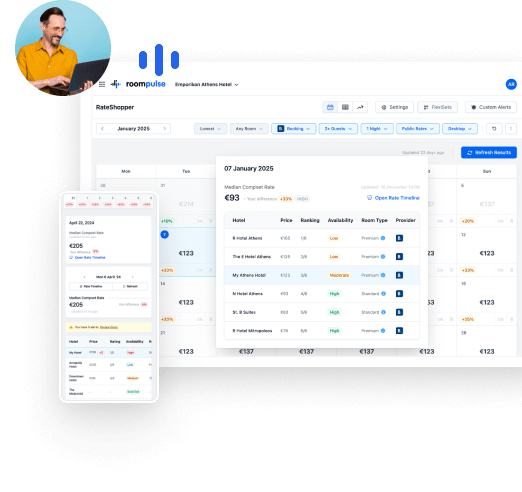
Competitor-based pricing monitors and adjusts your rates based on what similar hotels in your market are offering. When implementing it, compare like-with-like: similar star rating, location, room types, and review scores - not just the cheapest property in town.
Example: You stay €10-€15 above a specific competitor because of better reviews and included breakfast, or €5 under a slightly superior competitor to capture price-sensitive guests.
Relying too heavily on competitor pricing can lead to a race to the bottom. Use it as a benchmark, not a strict roadmap. Rate shopping tools give independent hotels access to real-time competitor rates across Booking.com, Expedia, and Agoda.
Value-added and package pricing
Value-added pricing lets hotels set rates higher than local competition while bundling extras into the basic package, creating a perception of premium experience.
Example: A "Premium Room & Breakfast" package priced €30 higher than room-only, where the actual cost of breakfast and late check-out is €12-€15. Margins stay protected while perceived value increases.
This approach proves especially useful when competitors engage in discount wars - you maintain ADR while offering more for the price. Upselling and cross-selling during the booking process can further boost total revenue per guest.
Loyalty-, incentive-, and promotion-based pricing
Loyalty-based pricing rewards returning customers with exclusive rates or discounts. For direct bookings, promo codes, early-booking discounts, and referral credits maintain or improve net revenue after OTA commission savings (typically 15-25%).
Short, time-boxed promotions tied to specific off-peak periods (midweek November 2026 stays, for instance) help fill occupancy without permanent discounting that erodes rate integrity.
Cancellation policy-based pricing
Different cancellation policies create separate price points for the same room on the same night:
| Policy type | Rate example | Target guest |
|---|---|---|
| Fully flexible | €169 | Uncertain travel plans |
| Semi-flexible | €149 | Some flexibility needed |
| Non-refundable | €139 | Price-sensitive, certain dates |
This structure lets guests self-segment based on risk tolerance. Tracking cancellation and no-show patterns (industry average 5-10%) helps refine the price gaps over time. Non-refundable rates are prioritized during high demand to protect against last-minute cancellations.
Behavioral and psychological pricing tactics
These tactics don't replace sound pricing strategies - they amplify conversion by aligning with how guests perceive value.
Price presentation
€199 feels meaningfully more attractive than €200. Framing "€220 including breakfast" often outperforms "€199 room only" by 18% in conversion studies. How you present rates matters as much as the rates themselves.
Anchoring and framing
Show premium rooms or suites first so standard rooms feel like better value. When a guest sees the €359 Junior Suite before the €199 Superior Double, the standard room looks like a smart choice rather than a compromise.
Scarcity and urgency
Messages like "Only 2 rooms left for these dates" boost urgency by 30% when they reflect real inventory. Fake scarcity erodes trust - negative reviews mentioning deceptive tactics cost more than the short-term conversion gain.
Consistency and transparency
Psychological tactics must remain honest to comply with regulations and maintain guest expectations. Consistent pricing across channels prevents confusion and chargebacks.
Common mistakes in hotel pricing (and how to avoid them)
Avoiding a few frequent mistakes often matters more than adding another advanced pricing model.
Static seasonal pricing
Properties using simple "high / shoulder / low" rate calendars miss revenue during unexpected demand spikes or dips. When a major conference is announced for your shoulder season, static rates leave 20% or more on the table.
Race-to-the-bottom discounting
Constantly undercutting competitors erodes both ADR and brand value. A 3-star hotel consistently pricing like a budget property trains guests to expect those lower prices permanently - a 15-25% ADR erosion that's difficult to recover.
Ignoring booking pace
Failure to respond to slow or fast pick-up means either leaving money on the table (raising rates too late) or ending up with empty rooms (not adjusting when demand softens).
Not differentiating by segment
Offering the same rate to corporate clients, groups, and OTA leisure travelers creates channel-mix problems and misses revenue optimization opportunities across customer segments.
Poor rate fences
When guests see wildly different prices with no clear explanation, complaints and chargeback risk increase. Every rate variation needs a logical justification.
Quick audit checklist:
- ADR variance exceeds 20% for similar dates without clear demand reason
- Gap with key competitors exceeds 15% without value justification
- Pick-up anomalies (significantly above or below prior year) without rate response
Hotel pricing compliance and rate parity
Hotel pricing compliance means staying within legal, contractual, and ethical rules while setting room prices.
Legal and tax requirements: Regulations differ by country and region. European city taxes, US resort fees, and local levies must appear clearly. Rates should show mandatory charges to avoid disputes and maintain guest trust.
Rate parity agreements: Typical OTA contracts require equal or better rates on all publicly visible booking channels. Member-only rates and direct-booking perks (loyalty discounts, included extras) typically fall outside parity requirements when structured correctly.
Transparency and fair display: Clear communication of inclusions, cancellation policies, black-out dates, and fees prevents negative reviews. Guests who feel misled become vocal critics.
Internal controls: Periodic audits of rates across main OTAs and your direct website ensure consistency. Accidental undercuts or overpricing damage both revenue and market positioning.
Using data and technology to power your pricing strategy
Modern hotel revenue management relies on data: historical performance, current pick-up, competitor rates, and forward-looking market demand.
Internal data to track weekly:
- Occupancy by segment (corporate, leisure, group)
- ADR and RevPAR trends
- Booking pace versus same period last year
- Cancellation and no-show rates
- Channel mix (direct vs. OTA split)
Competitor and market data: Real-time visibility into competitor room prices, promotions, and sell-out patterns prevents pricing blind spots. Without this data, you're guessing whether your rates align with market conditions.
Revenue Management Systems (RMS): An RMS supports data-driven decision-making rather than manual rate changes. Combined with channel managers and BI dashboards, these tools reduce manual work and catch opportunities that human review misses.
Roompulse for competitor intelligence: Roompulse centralizes competitor pricing from Booking.com, Expedia, and Agoda, tracks competitor pace (how fast their inventory sells), and surfaces alerts for demand spikes or local events. The intelligent alerts system notifies revenue managers when the market shifts, enabling proactive rather than reactive pricing decisions.
Scenario: A 40-room boutique hotel uses Roompulse alerts about a newly announced concert in October 2026. The alert arrives three weeks before competitors react. By raising rates earlier and monitoring competitor responses, the hotel captures 12% higher ADR than properties that adjusted later.
Step-by-step framework to build or redesign your pricing strategy
This roadmap helps revenue managers or GMs move from static to strategic pricing within 90 days.
Step 1: Audit current performance
Review room rates and performance for the last 12 months by segment, channel, and season. Identify clear underpriced periods (high occupancy but low ADR) and over-discounted segments. Assess how discounted rates have been used for specific guest segments or targeted promotions, and their impact on occupancy and revenue.
Step 2: Define revenue objectives
Set specific goals: increase ADR by 8% while keeping occupancy above 70%, or grow TRevPAR by focusing on premium rooms and additional services. Clear targets guide every pricing decision.
Step 3: Select your pricing backbone
Choose a primary approach (dynamic demand-based plus occupancy thresholds) and 2-3 supporting methods (LOS controls, value-added pricing, segment-based rates). Don't try to implement everything simultaneously.
Step 4: Map your demand calendar
Build a month-by-month calendar for 2026-2027 marking known events, holidays, school breaks, and typical shoulder periods based on historical data and market intelligence.
Step 5: Establish monitoring routines
Review booking pace, competitor rates, and market alerts at least 3x weekly. Define decision rules: at what pick-up level do you raise rates? When do you lower them?
Step 6: Test and iterate
Try 10-15% rate increases on strong-demand weekends or new LOS rules for one month. Measure impact via ADR, RevPAR, and reviews. Scale what works.
This framework is cyclical: review results quarterly, refine strategies, and update your demand calendar as market trends evolve.
How competitor intelligence completes the picture
Even the best internal revenue strategy fails without visibility into what competitors are doing - especially in competitive urban and resort destinations.
The risks of flying blind: Without competitor data, you risk pricing far below the market during compression nights, missing high-rate opportunities around local events, or staying too high when supply and demand shifts. Properties without consistent pricing intelligence leave 10-15% revenue on the table annually.
What good competitor intelligence looks like:
- Daily visibility into competitor room prices by date and room type
- Ability to compare premium rooms versus standard rooms across your competitive set
- Quick detection of sudden price moves (competitor drops €30 for next weekend)
- Understanding of competitor pace - how fast their inventory is selling
Roompulse's role: Roompulse provides rate shopping across major OTAs, competitor pace analysis, event impact tracking, and intelligent alerts when market conditions change. The platform tracks 20M+ competitor rates daily across 150+ countries.
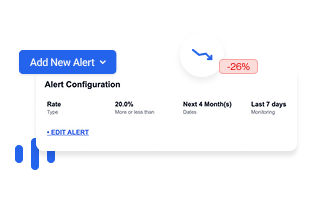
Before/after: a 55-room independent hotel: A 55-room independent hotel in Lisbon previously relied on manual spot checks - checking competitor rates on Booking.com twice weekly when time allowed. Pricing decisions were reactive, often arriving days after competitors had already adjusted. After implementing Roompulse, the revenue manager receives automatic alerts when competitors adjust rates or when local events impact demand. During a major tech conference announcement, the hotel raised rates 10 days before competitors noticed, capturing €18 higher ADR for that week. Over six months, RevPAR increased 14% compared to the same period prior year.
Tools like Roompulse don't replace pricing strategy - they give revenue managers better information to apply the strategies outlined throughout this guide.
Conclusion: modern pricing strategies are built on data and discipline
A hotel pricing strategy is essential for success and for staying competitive. Profitable strategies combine a solid understanding of fixed and variable costs, clear revenue goals, dynamic response to market demand, and smart segmentation across customer segments. There's no single "correct" approach - the right mix depends on your hotel's location, competitive set, and guest profile.
Regular review, experimentation, and alignment across teams (GM, front office, sales, revenue) matter more than implementing every possible strategy at once. Start with a backbone approach, add supporting tactics, and iterate based on results.
Competitor and market data belongs alongside demand forecasting, segmentation, and value proposition as one of the four essential pillars of an overall revenue management strategy. It's not an optional add-on for hotels serious about revenue growth.